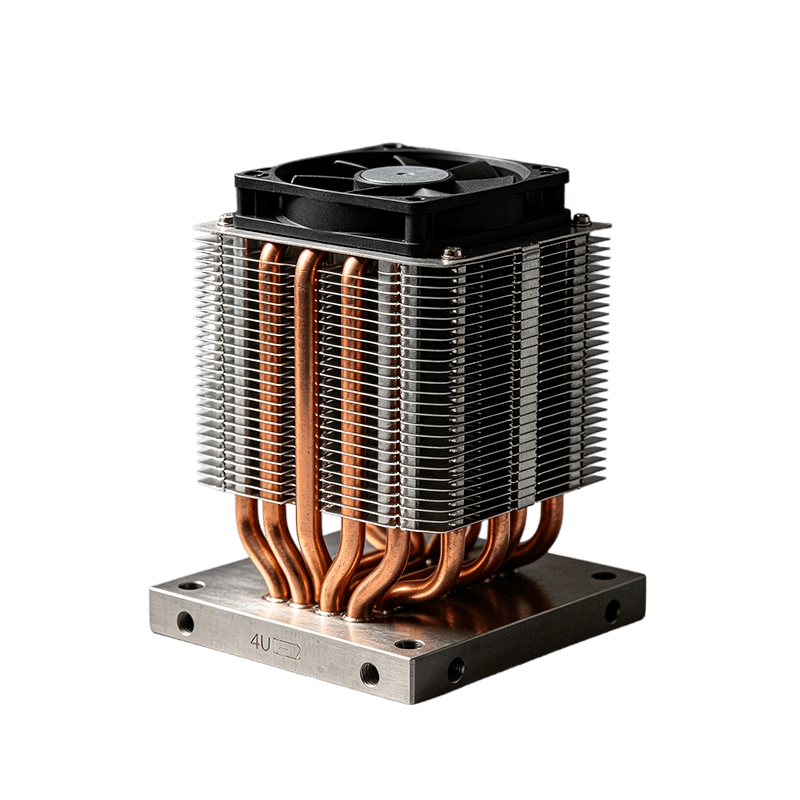
4U Server CPU Heat Sink
The 4U server CPU heat sink is a universal thermal control component for 4U rack-mounted industrial servers. It adopts expanded heat dissipation area design to adapt to high-power CPU heat generation demands, providing stable and continuous thermal protection for medium and high-load industrial servers under long-time continuous operating conditions.
CORE FEATURES
Large-area heat dissipation structure enhances overall heat exchange capacity.
Reserved structural space provides margin for high-power heat dissipation.
Standard 4U rack design ensures high universal compatibility.
Stable environmental adaptability suits complex industrial operating scenarios.
TECHNICAL SPECIFICATIONS
| Parameter | Specification |
| Dimension | Standard 4U server dedicated size |
| Weight | Industrial standard structural weight |
| Material | High thermal conductivity metal alloy |
| Supported TDP | Medium to high power server CPU range |
| Structural Advantage | Expandable heat dissipation layout |
4U Server CPU Heat Sink for Industrial and Rack-Mounted Servers
Jadecooling Tech provides 4U Server CPU Heat Sink solutions for industrial servers, rack-mounted computing systems and medium-to-high-load server applications. Designed with an expanded heat dissipation structure, this product provides additional thermal management space for processors operating under sustained workloads.
Compared with compact 2U server cooling structures, a 4U chassis generally offers more internal space for heat sink design and thermal component arrangement. This provides greater flexibility when evaluating heat dissipation area, structural dimensions and airflow coordination.
For server manufacturers and OEM/ODM buyers, selecting a suitable 4U Server CPU Heat Sink requires considering processor thermal load, available installation space, heat transfer efficiency and the server's internal airflow conditions.
Key Design Factors for 4U Server CPU Heat Sinks
1. Expanded Heat Dissipation Area
A larger heat dissipation surface can provide more area for heat exchange with the surrounding air. The heat sink structure should be designed according to the processor's thermal requirements and the available installation space.
Important design considerations include:
-
Effective heat dissipation surface area.
-
Heat sink base dimensions and thermal contact area.
-
Fin arrangement and spacing.
-
Overall structural dimensions.
-
Material thermal conductivity.
An appropriate fin structure helps balance heat exchange efficiency, airflow resistance and manufacturing requirements.
2. CPU Thermal Load and Cooling Capacity
Different server processors generate different amounts of heat depending on their power consumption and operating workloads.
When selecting a 4U Server CPU Heat Sink, buyers should consider the CPU model, TDP, operating temperature and expected workload conditions.
For medium-to-high-load server applications, thermal evaluation should consider the actual operating environment rather than relying exclusively on the processor's rated TDP.
The heat sink should be assessed together with the complete server cooling configuration to ensure that the thermal requirements can be met during sustained operation.
3. Server Airflow and Heat Exchange Efficiency
The internal airflow system plays an important role in determining server cooling performance.
In rack-mounted servers, chassis fans establish an airflow path that carries heat away from internal components. The heat sink orientation and fin structure should be evaluated according to this airflow direction.
For 4U server applications, buyers should consider:
-
Airflow direction through the chassis.
-
Heat sink orientation relative to cooling fans.
-
Airflow distribution around the CPU.
-
Fin spacing and potential airflow resistance.
-
Clearance between the heat sink and surrounding components.
Coordinating the heat sink structure with the server's airflow system helps improve overall heat exchange efficiency.
4. Material Selection and Structural Stability
Material selection influences thermal conductivity, mechanical strength, overall weight and manufacturing cost.
For industrial server applications, the selected material should meet the required heat transfer performance while maintaining sufficient structural stability.
The material and structural design should also be evaluated according to the operating environment, installation conditions and expected service requirements.
5. Installation Compatibility and Mechanical Dimensions
A 4U Server CPU Heat Sink must fit the target motherboard and server chassis.
Although 4U chassis generally provide more installation space than lower-profile server enclosures, the actual available clearance varies between different server platforms.
Before confirming a design, buyers should check:
-
CPU socket and mounting interface.
-
Heat sink height, width and length.
-
Available space above the processor.
-
Clearance around memory modules and motherboard components.
-
Chassis fan and structural component positions.
-
Installation and fastening requirements.
Confirming these dimensions before production helps reduce mechanical interference and assembly problems.
Custom 4U Server CPU Heat Sink Development
Jadecooling Tech supports customized 4U Server CPU Heat Sink development for industrial server manufacturers, computing equipment brands and OEM/ODM customers.
Customization directions include:
-
Heat Dissipation Area Adjustment: Modify the heat dissipation structure according to the target processor's thermal requirements.
-
High-Power Enhanced Structure: Evaluate structural improvements for server applications with increased thermal loads.
-
Environment-Adaptive Design: Optimize the structural configuration according to different server operating environments.
-
Dimensional Customization: Adjust overall dimensions and installation interfaces according to customer drawings.
-
Material Selection: Evaluate suitable high-thermal-conductivity metal alloys according to thermal and mechanical requirements.
Customers can provide 2D drawings, 3D models, existing samples or preliminary technical specifications for engineering evaluation.
For customized projects, the development process should consider thermal requirements, structural feasibility, installation compatibility and manufacturing consistency together.
What Should Buyers Confirm Before Purchasing a 4U Server CPU Heat Sink?
For bulk purchasing and customized server cooling projects, buyers should prepare the following information:
-
CPU Specifications: Provide the processor model, socket type and TDP.
-
Thermal Requirements: Specify the expected operating temperature, thermal load and workload conditions.
-
Installation Dimensions: Confirm the available height, width, length and mounting positions.
-
Airflow Configuration: Provide the server fan arrangement and internal airflow direction.
-
Material Requirements: Specify preferred materials, weight restrictions and surface treatment requirements.
-
Order Quantity: Confirm sample requirements, estimated production volume and expected delivery schedule.
Providing these details allows the engineering team to evaluate the heat sink structure and identify potential design or installation issues before prototype development.
Related Server Thermal Control Products
Different rack-mounted server configurations require different cooling structures. The appropriate heat sink should be selected according to processor thermal requirements, chassis dimensions and hardware layout.
For compact server platforms with more restrictive installation height requirements, explore our 2U Server CPU Heat Sink.
For high-density server systems using multiple processors, explore our Multi-CPU Integrated Server Heat Sink, which features an integrated heat conduction structure designed around multiple CPU positions.
Frequently Asked Questions About 4U Server CPU Heat Sinks
1. What Is a 4U Server CPU Heat Sink?
A 4U Server CPU Heat Sink is a thermal management component designed for CPU cooling in 4U rack-mounted server systems. It uses a heat dissipation structure to transfer heat away from the processor and release it into the surrounding airflow.
2. What Are the Advantages of a 4U Server CPU Heat Sink?
A 4U chassis generally provides more internal installation space than lower-profile server enclosures. This allows greater flexibility when designing the heat dissipation area, structural dimensions and cooling component arrangement.
3. How Do I Select a Heat Sink for a High-Power Server CPU?
Consider the CPU model, TDP, actual workload, operating temperature and available chassis airflow. The heat sink's thermal structure and installation dimensions should be evaluated together under representative operating conditions.
4. Can a 4U Server CPU Heat Sink Be Customized?
Yes. Customization can include heat dissipation area adjustments, enhanced structural designs, overall dimensional modifications and environment-adaptive configurations. Technical drawings or existing samples can help determine the appropriate design.
5. What Information Is Needed for a Custom 4U Server CPU Heat Sink Quotation?
Buyers should provide the CPU model, thermal requirements, motherboard layout, installation dimensions, airflow configuration, material preferences and estimated order quantity. These details help the engineering team assess customization feasibility and prepare a quotation.

COMPATIBILITY
Compatible with all mainstream 4U rack-mounted server equipment and industrial-grade server processors.
APPLICATION SCENARIOS
Industrial computing servers, medium-sized data center operating servers, long-term continuous load industrial server equipment.


CUSTOMIZATION CAPACITY


Supports adjustment of heat dissipation area structure.


Supports customization of high-power enhanced structure.


Supports optimization of environment-adaptive structure.