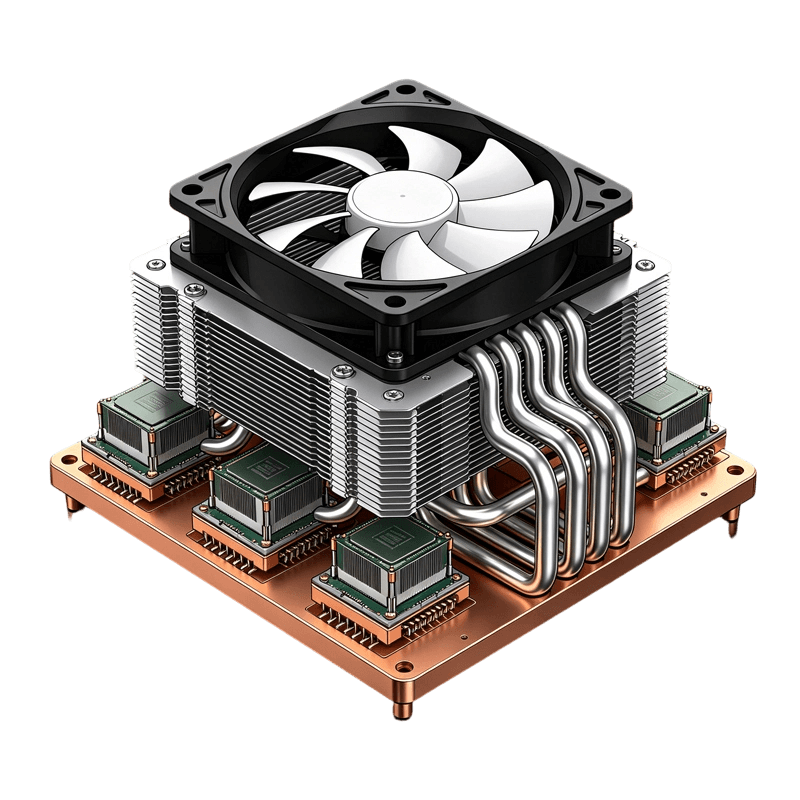
Multi-CPU Integrated Server Heat Sink
The multi-CPU integrated heat sink is an integral thermal control component designed for high-density multi-processor server equipment. Aiming at concentrated heat generation in closed server cabinet space, the product adopts integrated heat conduction layout to realize synchronous heat dissipation and balanced temperature control for multiple CPU heat sources, adapting to 24-hour continuous high-load operation of industrial servers.
CORE FEATURES
Integrated structural design realizes simultaneous heat dissipation for multiple processors.
Overall balanced thermal layout eliminates local hot spot accumulation.
High structural rigidity resists long-term equipment operating vibration.
Industrial-grade materials ensure stable performance under continuous operation.
TECHNICAL SPECIFICATIONS
| Parameter | Specification |
| Dimension | Customized for server integrated assembly space |
| Weight | Industrial standard structural weight |
| Material | High thermal conductivity industrial alloy |
| Supported TDP | High-power multi-processor combined power range |
| Heat Dissipation Mode | High-efficiency passive heat conduction |
| Structural Feature | Multi-core integrated positioning design |
Multi-CPU Server Heat Sink Assembly for High-Density Computing
Jadecooling Tech develops Multi-CPU Server Heat Sink Assembly solutions for high-density server platforms and multi-processor computing equipment. The integrated structure is designed to manage heat generated by multiple processors within a shared server assembly, supporting coordinated heat conduction and balanced thermal management.
Unlike individual CPU heat sinks installed separately, an integrated multi-CPU heat sink is designed around the relative positions of multiple processors, their combined thermal requirements and the available server installation space.
For server manufacturers and OEM/ODM customers, this integrated approach requires careful coordination of CPU contact positions, heat conduction paths, structural dimensions and chassis airflow. The objective is to develop a unified cooling structure that fits the target motherboard and supports stable operation under sustained computing workloads.
How Does an Integrated Multi-CPU Server Heat Sink Work?
A Multi-CPU Server Heat Sink Assembly manages heat generated by multiple processors through an integrated thermal conduction structure.
Each processor creates a concentrated heat source during operation. The integrated heat sink must accommodate these heat sources while maintaining suitable thermal contact and heat distribution across the assembly.
Several design elements influence its performance:
1. Multiple CPU Contact Positions
The contact areas must correspond accurately to the CPU socket positions on the server motherboard. Their spacing, alignment and mounting requirements determine the overall structural layout.
Accurate positioning helps establish consistent mechanical contact between the processors and the corresponding heat sink areas.
2. Integrated Heat Conduction Structure
An integrated structure coordinates heat transfer from multiple CPU contact areas within one assembly. The thermal conduction layout should account for the combined heat generation and the interaction between adjacent heat sources.
Material selection, contact geometry and structural dimensions all influence the effectiveness of heat transfer.
3. Thermal Balance Across Multiple Processors
Multiple CPUs operating simultaneously can create several concentrated thermal zones within a confined server enclosure.
The heat sink structure should be evaluated to reduce localized heat accumulation and support more balanced thermal distribution across the processors.
4. Coordination with Server Airflow
Passive heat conduction depends on the surrounding thermal environment to remove the heat transferred into the heat sink structure.
The orientation of the assembly, available airflow space and server fan arrangement should therefore be considered during the design stage. Proper coordination with the chassis airflow path helps support the overall cooling system.
Key Design Considerations for Multi-CPU Server Heat Sink Assemblies
Developing an integrated server heat sink requires more than combining several individual CPU cooling structures. The mechanical and thermal requirements of the complete server platform must be evaluated together.
1. CPU Spacing and Motherboard Layout
Different server motherboards use different processor arrangements. CPU socket spacing directly affects the heat sink dimensions, contact positions and structural configuration.
Buyers should provide motherboard drawings or 3D layout files to confirm the distance between processors and surrounding component clearances.
2. Combined CPU Thermal Load
The combined thermal requirements of multiple processors are important when selecting the heat conduction structure.
Engineering evaluation should consider the thermal load of each CPU, simultaneous operating conditions and potential temperature differences between processor positions.
Using the combined power requirement alone may not fully represent the actual thermal distribution. The position and operating conditions of each heat source should also be considered.
3. Installation Space and Structural Dimensions
Server chassis have defined height, width and internal assembly limitations. An integrated heat sink must fit within the available space without interfering with memory modules, power components or other motherboard hardware.
The design should account for:
-
Overall heat sink dimensions.
-
CPU socket positions and spacing.
-
Mounting hole locations.
-
Clearance around surrounding components.
-
Chassis height and internal layout.
-
Assembly and maintenance accessibility.
4. Material Selection and Structural Stability
The thermal conductive material affects heat transfer, overall weight and mechanical properties.
For multi-processor server applications, material selection should be evaluated together with the contact structure, overall dimensions and long-term operating requirements.
Structural rigidity is also important because the assembly must maintain its intended positioning during server operation and equipment vibration.
5. Long-Term Operating Conditions
Enterprise and industrial servers may operate continuously under demanding workloads. The cooling structure should therefore be evaluated under representative operating conditions.
Thermal validation should consider simultaneous processor operation, ambient conditions, chassis airflow and temperature distribution across the complete assembly.
OEM & ODM Customization for Multi-CPU Server Heat Sink Assembly
Jadecooling Tech supports customized Multi-CPU Server Heat Sink Assembly development for server manufacturers, industrial computing equipment manufacturers and enterprise hardware developers.
Customization can be evaluated according to the following requirements:
-
CPU Spacing Layout: Adjust processor positioning and contact area arrangements according to the motherboard design.
-
Overall Structural Dimensions: Modify the assembly size to match the available server chassis space.
-
Thermal Conductive Materials: Evaluate material specifications according to heat transfer, structural and weight requirements.
-
Heat Conduction Structure: Optimize the integrated thermal layout for multiple processor heat sources.
-
Mounting and Positioning: Customize the positioning structure and mounting interfaces to match the target hardware platform.
-
Manufacturing Adaptation: Review the design for prototype development, assembly requirements and repeatable production.
Customers can provide existing heat sink samples, motherboard drawings, 2D engineering drawings or 3D models for technical evaluation.
From initial structural review to prototype development and production preparation, the customization process should consider thermal performance, mechanical compatibility and manufacturing feasibility together.
What Should Buyers Prepare Before Ordering a Multi-CPU Server Heat Sink Assembly?
For B2B purchasing projects, providing accurate technical information helps reduce design revisions and improve quotation efficiency.
Before requesting a quotation, buyers should prepare:
-
CPU Configuration: Number of processors, CPU models, socket types and processor positioning.
-
Thermal Requirements: Individual CPU TDP, combined thermal load and expected operating conditions.
-
Motherboard Drawings: PCB layout, CPU spacing, mounting hole positions and surrounding component dimensions.
-
Chassis Information: Available installation height, overall assembly space and internal airflow direction.
-
Material Requirements: Preferred thermal conductive materials and any structural or weight restrictions.
-
Order Requirements: Prototype quantity, estimated production volume and customization expectations.
These details allow the engineering team to evaluate the integrated heat sink structure and identify potential thermal or mechanical challenges before prototype development.
Related Server Thermal Control Products
Different server architectures require different cooling structures. The appropriate solution depends on processor configuration, chassis dimensions and thermal requirements.
For rack-mounted servers with limited installation height, explore our 2U Server CPU Heat Sink, designed around compact 2U chassis requirements.
For server applications with more available installation space and expanded heat dissipation requirements, explore our 4U Server CPU Heat Sink.
Selecting the right server cooling component requires matching the thermal structure with the complete hardware platform rather than considering processor power alone.
Frequently Asked Questions About Multi-CPU Server Heat Sink Assemblies
1. What Is a Multi-CPU Server Heat Sink Assembly?
A Multi-CPU Server Heat Sink Assembly is an integrated thermal management component designed to dissipate heat from multiple processors within a server system. Its structure is developed around CPU positioning, combined thermal requirements and available installation space.
2. What Is the Advantage of an Integrated Multi-CPU Heat Sink?
An integrated structure coordinates multiple CPU contact positions within one assembly. It can simplify the overall thermal structure and support coordinated heat conduction across multiple processors, provided that the design matches the motherboard and thermal requirements.
3. Can a Multi-CPU Server Heat Sink Be Customized for Different Motherboards?
Yes. Customization can include CPU spacing, contact positions, overall dimensions, mounting structures and material selection. Motherboard drawings and 3D models help determine the required structural configuration.
4. How Do You Evaluate the Cooling Requirements of Multiple CPUs?
The evaluation should consider each processor's thermal load, combined operating conditions, processor spacing, thermal interaction and server airflow. Testing under representative simultaneous workloads helps assess the thermal performance of the integrated assembly.
5. What Information Is Required for a Custom Multi-CPU Server Heat Sink Quotation?
Buyers should provide CPU models, socket arrangements, motherboard drawings, individual and combined thermal requirements, chassis dimensions and estimated order quantities. Existing samples or 3D design files can also support technical evaluation.

COMPATIBILITY
Compatible with mainstream high-density multi-CPU server motherboards and standard industrial server cabinets.
APPLICATION SCENARIOS
Enterprise high-performance computing servers, industrial data processing servers, multi-processor parallel operation equipment.


CUSTOMIZATION CAPACITY


Supports customization of CPU spacing layout.


Supports overall structural size adjustment based on cabinet space.


Supports optimization of material thermal conductivity parameters.