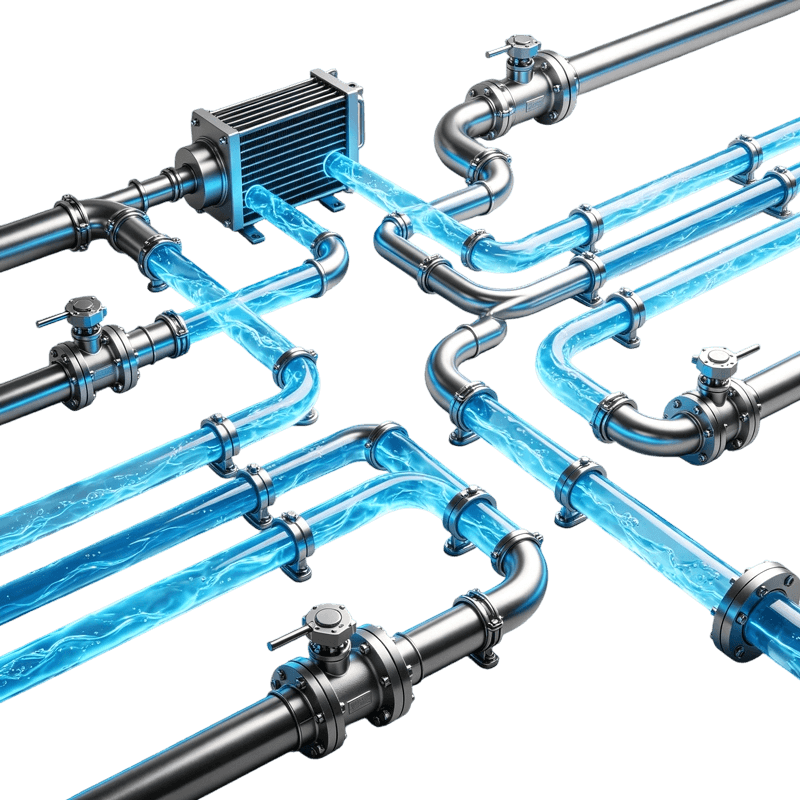
Liquid Cooling Pipeline Network
The liquid cooling pipeline network is the core circulating structural component of data center liquid cooling heat dissipation systems. It undertakes closed-loop transmission of cooling liquid between liquid cooling modules, forming complete circulating heat exchange systems for high-density server clusters and supporting long-term stable heat dissipation operation of data center equipment.
CORE FEATURES
Closed-loop pipeline layout ensures stable and continuous liquid transmission.
Anti-leakage and anti-aging structure adapts to long-term cyclic operation.
Modular layout facilitates overall system maintenance and inspection.
Smooth inner wall reduces liquid circulating resistance.
TECHNICAL SPECIFICATIONS
| Parameter | Specification |
| Specification | Data center modular pipeline standard |
| Material | High-toughness anti-corrosion pipeline material |
| Working Flow | Conventional liquid cooling system flow range |
| Working Pressure | Industrial standard circulating pressure |
| Durability | Long-term industrial anti-aging performance |
Liquid Cooling Pipeline Network for Data Center Cooling Systems
As part of its Data Center Liquid Cooling Components portfolio, Jadecooling Tech provides customized Liquid Cooling Pipeline Networks for data centers, high-density servers and computing infrastructure. The pipeline network is designed to transport coolant between cooling modules, manifolds and distribution points, supporting continuous circulation and heat exchange throughout the liquid cooling system.
In a typical direct-to-chip liquid cooling architecture, coolant travels through supply pipelines from the coolant distribution unit (CDU) to server cooling components, such as manifolds and cold plates. After absorbing heat from CPUs, GPUs and other high-power computing components, the coolant returns through dedicated return pipelines for further heat exchange.
For data center operators and server manufacturers, an effective liquid cooling pipeline network requires coordinated planning of pipeline routing, diameter, flow rate, pressure conditions, material compatibility and installation space.
How Does a Data Center Liquid Cooling Pipeline Network Work?
A liquid cooling pipeline network establishes the coolant transportation paths within a liquid cooling system. It connects the coolant distribution equipment with individual cooling modules and provides separate supply and return paths for continuous fluid circulation.
The main functions include:
-
Coolant Transportation: Delivers cooling liquid from the distribution unit to server cooling components.
-
Supply and Return Circulation: Establishes separate coolant supply and return paths to maintain continuous circulation.
-
Multi-Branch Distribution: Connects different cooling modules and distribution points within the same system.
-
Hydraulic Coordination: Supports appropriate pipeline dimensions and routing to help manage flow distribution and pressure loss.
-
Modular System Integration: Facilitates equipment installation, maintenance and future pipeline layout adjustments.
The specific network configuration depends on the data center architecture, cooling capacity, rack arrangement and number of connected cooling modules.
Key Design Considerations for Liquid Cooling Pipeline Networks
1. Pipeline Layout and Routing
Pipeline routing directly affects installation efficiency, maintenance accessibility and overall system integration.
For high-density data centers, pipeline networks may need to connect multiple server racks, manifolds and cooling modules within limited installation spaces.
A suitable layout should consider:
-
Supply and return pipeline arrangements.
-
Connections between CDUs, manifolds and server cooling modules.
-
Pipeline length and routing direction.
-
Bending radius and connection positions.
-
Available rack and equipment installation space.
-
Maintenance and inspection accessibility.
For customized projects, the overall pipeline layout should be evaluated according to the actual data center floor plan and server rack configuration.
2. Pipeline Diameter and Coolant Flow Rate
Pipeline diameter influences coolant transportation capacity and hydraulic resistance.
An appropriately selected diameter helps accommodate the required flow rate while avoiding unnecessary pressure loss and excessive pumping requirements.
Buyers should consider:
-
Required coolant flow rate.
-
Pipeline inner diameter.
-
Number of connected cooling branches.
-
Total pipeline length.
-
Flow velocity and hydraulic resistance.
-
Allowable pressure drop.
For multi-rack liquid cooling systems, the pipeline dimensions should be evaluated according to the combined cooling requirements and individual branch flow conditions.
3. Working Pressure and Pressure Drop
Liquid cooling pipelines operate under the pressure conditions established by the circulation system.
Pressure drop occurs as coolant passes through straight pipe sections, bends, connectors, valves and other flow components.
An effective pipeline design should evaluate the total hydraulic resistance rather than considering individual pipe sections separately.
Important factors include:
-
Normal operating pressure.
-
Required flow rate.
-
Pipeline length and diameter.
-
Number of bends and connection points.
-
Internal surface characteristics.
-
Pressure losses across fittings and distribution components.
These factors help determine whether the pipeline configuration can meet the circulation requirements of the intended cooling system.
4. Material Selection and Coolant Compatibility
Pipeline materials should be selected according to coolant chemistry, operating pressure, temperature and environmental conditions.
Material compatibility is particularly important in closed-loop liquid cooling systems, where pipelines remain in contact with circulating coolant over extended operating periods.
Buyers should evaluate:
-
Corrosion resistance.
-
Compatibility with the selected coolant.
-
Resistance to aging and temperature fluctuations.
-
Mechanical strength under operating pressure.
-
Compatibility between pipeline materials and connecting components.
The material selection process should also consider potential corrosion risks between dissimilar metals and the compatibility of sealing materials with the coolant formulation.
5. Leakage Prevention and Connection Reliability
Leakage prevention is essential for data center liquid cooling infrastructure because coolant leakage can damage nearby electronic equipment and interrupt server operation.
A reliable pipeline network requires appropriate connection structures, sealing components and manufacturing quality control.
Key considerations include:
-
Pipeline joint and connection integrity.
-
Sealing performance under working pressure.
-
Resistance to thermal cycling and mechanical stress.
-
Inspection of connection points.
-
Pressure and leakage testing before commissioning.
For systems requiring frequent maintenance, pipeline connections should also be arranged to support convenient isolation and component replacement.
6. Modular Design and Maintenance Accessibility
Large data center liquid cooling systems may contain multiple racks and cooling branches. A modular pipeline layout helps organize the coolant distribution structure and simplifies maintenance planning.
The design should consider accessible connection points, isolation arrangements, pipeline identification and potential system expansion.
A well-planned modular structure can help maintenance teams inspect individual pipeline sections and service specific cooling modules without unnecessarily disturbing the entire system, subject to the system's isolation configuration.
Custom Liquid Cooling Pipeline Network Development
Jadecooling Tech supports customized Liquid Cooling Pipeline Network development for data center equipment manufacturers, server manufacturers, liquid cooling system integrators and OEM/ODM customers.
Customization can be evaluated according to the following requirements:
-
Overall Pipeline Layout: Plan the pipeline arrangement according to server rack configuration and cooling system architecture.
-
Pipeline Diameter: Customize pipeline caliber specifications according to required coolant flow and connection requirements.
-
Pipeline Length: Adjust individual pipeline lengths according to installation positions and equipment spacing.
-
Closed-Loop System Matching: Evaluate the pipeline configuration according to the circulation requirements of the complete liquid cooling system.
-
Structural and Connection Adaptation: Review pipeline routing and connection positions according to the actual equipment layout.
Customers can provide system diagrams, pipeline drawings, 2D engineering files or 3D models for technical evaluation.
From initial layout planning to prototype evaluation and production preparation, the development process should consider hydraulic requirements, mechanical compatibility and manufacturing feasibility together.
What Should Buyers Prepare Before Ordering a Custom Liquid Cooling Pipeline Network?
For data center liquid cooling projects, complete technical information helps suppliers evaluate pipeline dimensions, routing requirements and system compatibility.
Before requesting a quotation, buyers should prepare:
-
System Architecture: Provide the liquid cooling system diagram, including CDU, manifold, cold plate and pipeline connection positions.
-
Pipeline Layout: Share the server rack arrangement, pipeline routing and required installation lengths.
-
Flow Requirements: Specify the target coolant flow rate and individual branch flow requirements.
-
Pressure Conditions: Provide normal working pressure, maximum operating pressure and allowable pressure drop.
-
Coolant Specifications: Identify the coolant type, chemical composition and operating temperature range.
-
Material Requirements: Specify preferred pipeline materials and corrosion resistance requirements.
-
Connection Specifications: Provide the interface dimensions and mating component requirements.
-
Order Information: Confirm prototype quantities, estimated production volume and customization requirements.
These details help the engineering team evaluate the pipeline network configuration and determine suitable dimensions and connection arrangements before production.
Applications of Liquid Cooling Pipeline Networks
Liquid Cooling Pipeline Networks are used in different computing environments where continuous coolant transportation and reliable heat exchange are required.
Typical applications include:
-
AI Data Centers: Supports coolant circulation for high-density AI computing servers and GPU clusters.
-
High-Performance Computing (HPC): Connects cooling distribution equipment with high-performance computing hardware.
-
Cloud Computing Infrastructure: Provides coolant transportation for large-scale server clusters and cloud computing facilities.
-
Rack-Level Liquid Cooling: Establishes supply and return connections between rack distribution equipment and individual servers.
-
Industrial Computing Systems: Supports customized liquid cooling circulation for high-power computing equipment.
Related Data Center Liquid Cooling Components
A complete liquid cooling system requires different components to work together. Each component performs a specific function within the coolant circulation and heat exchange process.
-
Liquid Cooling Quick Connector: Provides detachable pipeline connections for convenient assembly, equipment replacement and maintenance. Explore our Liquid Cooling Quick Connector.
-
Liquid Cooling Cold Plate: Transfers heat directly from CPUs, GPUs and other high-power chips into the circulating coolant. Explore our Liquid Cooling Cold Plate.
-
Manifold: Distributes coolant across multiple branches and collects return liquid from different cooling modules. Explore our Manifold.
Coordinating these components helps establish an integrated liquid cooling architecture for data center and high-density server applications.
Frequently Asked Questions About Liquid Cooling Pipeline Networks
1. What Is a Liquid Cooling Pipeline Network?
A Liquid Cooling Pipeline Network is a connected system of coolant supply and return pipelines that transports cooling liquid between distribution equipment and heat exchange components. It supports continuous coolant circulation in data centers and other liquid cooling applications.
2. What Is the Difference Between a Liquid Cooling Pipeline and a Manifold?
A liquid cooling pipeline transports coolant between different equipment and cooling components. A manifold distributes coolant across multiple branches or collects return liquid from different cooling modules. Both components work together to support balanced coolant circulation.
3. How Do I Choose the Correct Pipeline Diameter?
Pipeline diameter should be selected according to the required coolant flow rate, flow velocity, pipeline length, hydraulic resistance and allowable pressure drop. The number of connected cooling branches should also be considered.
4. What Materials Are Suitable for Data Center Liquid Cooling Pipelines?
Suitable materials depend on coolant chemistry, operating pressure, temperature and corrosion resistance requirements. Buyers should evaluate the compatibility of pipeline materials, connectors and sealing components with the complete coolant formulation.
5. How Can Leakage Risks Be Reduced in a Liquid Cooling Pipeline Network?
Leakage risks can be reduced through appropriate material selection, reliable connection structures, suitable sealing components and inspection before commissioning. Pressure testing and leakage testing should also be included in the system validation process.
6. Can Liquid Cooling Pipeline Networks Be Customized?
Yes. Jadecooling Tech supports customized overall pipeline layouts, pipeline diameters, lengths and closed-loop circulation system matching according to project requirements. Buyers can provide engineering drawings or system diagrams for evaluation.

COMPATIBILITY
Compatible with all self-developed data center liquid cooling components and mainstream modular liquid cooling systems.
APPLICATION SCENARIOS
Large-scale data center cluster liquid cooling systems, high-density server liquid cooling circulation equipment, industrial constant temperature liquid cooling systems.


CUSTOMIZATION CAPACITY


Supports personalized planning of overall pipeline layout.


Supports customization of pipeline caliber and length specifications.


Supports matching adjustment of closed-loop circulating systems.