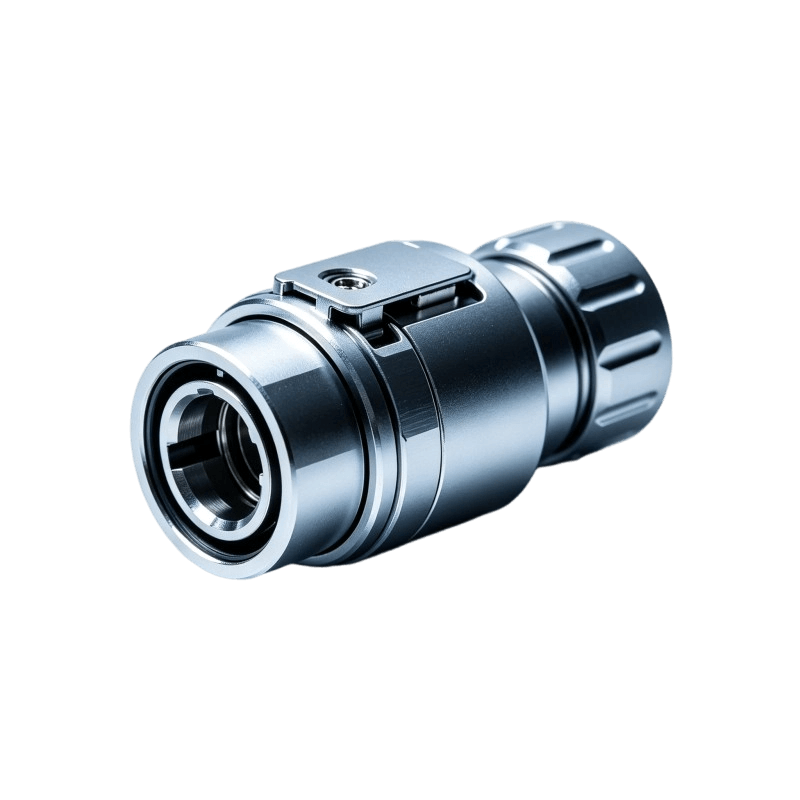
Liquid Cooling Quick Connector
The liquid cooling quick connector is a sealing and connecting component for data center liquid cooling circulating systems. It supports rapid assembly and disassembly of liquid cooling pipelines and modules under non-drainage conditions, maintaining system airtightness and operational stability during equipment maintenance and replacement of liquid cooling components.
CORE FEATURES
Tool-free plug-in structure realizes rapid assembly and disassembly.
High-sealing structure effectively prevents liquid leakage in circulating systems.
Anti-corrosion materials adapt to long-term liquid circulation working environment.
Standard interface design ensures universal assembly compatibility.
TECHNICAL SPECIFICATIONS
| Parameter | Specification |
| Dimension | Industrial standard pipeline matching size |
| Weight | Lightweight sealing structure |
| Material | Anti-corrosion alloy + wear-resistant sealing rubber |
| Working Pressure | Standard data center liquid cooling pressure range |
| Working Temperature | Conventional liquid cooling system operating range |
| Connection Mode | Self-locking quick plug structure |
Liquid Cooling Quick Connector for Data Center Cooling Systems
As part of its Data Center Liquid Cooling Components portfolio, Jadecooling Tech provides Liquid Cooling Quick Connectors for data center liquid cooling circulation systems, supporting rapid connection and disconnection of coolant pipelines and cooling modules. Designed for liquid cooling infrastructure, the connector combines a self-locking connection structure with sealing components to support reliable coolant transportation and convenient equipment maintenance.
In direct-to-chip liquid cooling systems, quick connectors provide connection points between coolant pipelines, cold plates, manifolds and other liquid cooling components. They allow individual components or pipeline sections to be disconnected for inspection, replacement and maintenance without requiring the entire cooling circuit to be drained, subject to the system isolation and shut-off configuration.
For AI servers, high-performance computing (HPC) equipment and high-density data center racks, connector selection directly affects system sealing, coolant flow, pressure loss and maintenance efficiency.
How Does a Liquid Cooling Quick Connector Work?
A liquid cooling quick connector establishes a detachable connection between two sections of a coolant circulation system.
A typical quick-disconnect assembly consists of mating connector components, a locking mechanism and sealing elements. When properly connected, the locking structure secures the joint while the sealing interface maintains the required fluid-tight connection.
Depending on the connector design, internal shut-off mechanisms can also help limit coolant release during disconnection. For maintenance applications, the shut-off configuration should be evaluated together with the isolation valves and overall liquid cooling circuit.
The main functions include:
-
Rapid Connection and Disconnection: Supports convenient assembly and removal of coolant lines and liquid cooling modules.
-
Secure Mechanical Locking: Helps maintain a stable connection during equipment operation.
-
Sealing Protection: Reduces coolant leakage risks at pipeline connection points.
-
Maintenance Accessibility: Supports inspection, component replacement and modular equipment maintenance.
-
System Integration: Connects compatible pipelines, cold plates, manifolds and liquid cooling assemblies.
Key Factors When Selecting a Liquid Cooling Quick Connector
Selecting a suitable liquid cooling quick disconnect requires more than matching the connector diameter. Buyers should evaluate the hydraulic, mechanical and material requirements of the complete cooling circuit.
1. Connection Size and Coolant Flow Rate
Connector size affects the available internal flow passage and hydraulic resistance.
An undersized connector may restrict coolant flow and increase pressure drop, while an oversized connector may create unnecessary installation space and integration challenges.
Important parameters include:
-
Nominal connection diameter.
-
Internal flow passage dimensions.
-
Required coolant flow rate.
-
Flow coefficient (Cv).
-
Pressure drop across the connector.
For data center liquid cooling systems, the connector should be selected according to the flow requirements of the corresponding cooling branch rather than the pipeline diameter alone.
2. Working Pressure and Pressure Resistance
Liquid cooling connectors operate under the pressure conditions established by the circulation system.
Before selecting a connector, buyers should identify the normal operating pressure, maximum operating pressure and potential pressure fluctuations.
The following parameters should be confirmed:
-
Rated working pressure.
-
Maximum allowable operating pressure.
-
Burst pressure.
-
Pressure resistance under connected conditions.
-
Pressure retention after repeated connection cycles.
The connector should meet the pressure requirements of the complete liquid cooling loop, including its associated hoses, pipelines and cooling modules.
3. Sealing Performance and Coolant Leakage Prevention
Sealing reliability is one of the most important requirements for data center liquid cooling connectors.
Even small coolant losses can create maintenance problems and potential risks for nearby electronic equipment.
Buyers should evaluate:
-
Sealing structure and interface design.
-
Leakage performance during normal operation.
-
Fluid loss during connection and disconnection.
-
Sealing performance under different pressure conditions.
-
Seal durability after repeated mating cycles.
For applications requiring maintenance without draining the entire system, buyers should also confirm whether the connector incorporates suitable shut-off valves on the required sides.
4. Material and Coolant Compatibility
The connector body and sealing materials must be compatible with the selected coolant and operating environment.
Different cooling systems may use different coolant formulations, additives and operating temperatures. Material compatibility should therefore be confirmed before selecting a connector.
Important considerations include:
-
Corrosion resistance of wetted metal components.
-
Compatibility between sealing materials and coolant chemistry.
-
Resistance to aging during long-term circulation.
-
Material compatibility with coolant additives.
-
Potential galvanic corrosion between dissimilar metals.
Jadecooling Tech supports anti-corrosion material matching according to project requirements.
5. Connection and Locking Structure
The connection mechanism influences installation convenience, mechanical stability and maintenance efficiency.
A self-locking quick plug structure can help simplify assembly and disassembly while reducing the need for additional tools.
For customized data center applications, buyers should consider:
-
Connection and disconnection method.
-
Locking and release mechanism.
-
Mating force requirements.
-
Resistance to accidental disconnection.
-
Connector accessibility within rack spaces.
-
Required connection cycle life.
The locking structure should be compatible with the installation environment and expected maintenance frequency.
6. OCP UQD Interface and Compatibility Requirements
Universal Quick Disconnect (UQD) connectors are used in data center liquid cooling systems where standardized connection interfaces and cross-manufacturer compatibility may be required.
The Open Compute Project UQD specification defines requirements for interface dimensions and performance, including flow, pressure, temperature, fluid loss and connector durability.
For projects specifying OCP UQD compatibility, buyers should confirm:
-
Applicable UQD specification revision.
-
Nominal connector size and interface dimensions.
-
Plug and socket interchangeability.
-
Pressure and flow performance.
-
Fluid loss during disconnection.
-
Relevant test documentation.
Not every quick connector automatically meets OCP UQD requirements. Interface compatibility and compliance evidence should be verified before selecting a product for standardized rack cooling systems.
Custom Liquid Cooling Quick Connector Development
Jadecooling Tech supports customized Liquid Cooling Quick Connector development for data center equipment manufacturers, liquid cooling system integrators and OEM/ODM customers.
Customization can be evaluated according to the following requirements:
-
Connection Diameter: Customize interface caliber specifications to match different coolant pipelines and cooling modules.
-
Corrosion-Resistant Materials: Evaluate suitable anti-corrosion materials according to coolant chemistry and operating conditions.
-
Locking Structure: Optimize the locking mechanism according to installation requirements and connection frequency.
-
Mechanical Dimensions: Review the connector envelope, installation space and connection orientation.
-
System Interface Matching: Evaluate the connector interface according to the target pipeline, cold plate or manifold assembly.
For customized projects, customers can provide pipeline drawings, interface dimensions, 3D models or existing connector samples for engineering evaluation.
The development process should consider mechanical compatibility, sealing requirements, hydraulic performance and manufacturing feasibility together.
What Should Buyers Prepare Before Ordering Liquid Cooling Quick Connectors?
For data center liquid cooling projects, providing complete technical information helps suppliers evaluate connector suitability and customization requirements.
Before requesting a quotation, buyers should prepare:
-
Pipeline Specifications: Provide nominal diameter, internal diameter and connection interface requirements.
-
Coolant Information: Specify the coolant type, chemical composition and concentration of additives.
-
Flow Requirements: Provide target flow rate and allowable pressure drop or required Cv.
-
Pressure and Temperature: Specify normal working pressure, maximum pressure and operating temperature range.
-
Sealing Requirements: Confirm acceptable fluid loss, leakage requirements and whether dry-break disconnection is required.
-
Material Requirements: Specify preferred connector body and sealing materials, along with corrosion resistance requirements.
-
Installation Drawings: Provide 2D drawings, 3D models, hose connection details and available installation space.
-
Order Quantity: Confirm prototype quantities, estimated production volume and customization expectations.
These details allow the engineering team to evaluate the connector structure, sealing configuration and compatibility with the intended liquid cooling system.
Applications of Liquid Cooling Quick Connectors
Liquid cooling quick connectors are used in different equipment configurations where detachable coolant connections and convenient maintenance are required.
Typical applications include:
-
AI Server Liquid Cooling: Connects coolant lines and cooling modules in high-density AI computing systems.
-
Direct-to-Chip Liquid Cooling: Supports coolant connections between server pipelines and CPU or GPU cold plates.
-
Rack-Level Liquid Cooling: Provides detachable connection points for server cooling loops and rack distribution systems.
-
Modular Liquid Cooling Systems: Facilitates the installation, replacement and maintenance of modular cooling components.
-
Industrial Liquid Cooling Equipment: Supports coolant pipeline connections in industrial thermal management systems.
Frequently Asked Questions About Liquid Cooling Quick Connectors
1. What Is a Liquid Cooling Quick Connector?
A Liquid Cooling Quick Connector is a detachable fluid connection component used in liquid cooling circulation systems. It allows coolant pipelines and cooling modules to be connected or disconnected conveniently while maintaining the required sealing performance.
2. What Is the Difference Between a Quick Connector and a Standard Pipe Fitting?
A standard pipe fitting generally creates a fixed or semi-permanent pipeline connection, while a quick connector is designed for convenient connection and disconnection. Quick-disconnect structures are particularly useful in data center cooling systems that require modular maintenance and component replacement.
3. Can a Liquid Cooling Quick Connector Be Disconnected Without Draining the Entire System?
Certain quick-disconnect designs incorporate shut-off mechanisms that limit coolant release during disconnection. However, the actual maintenance procedure depends on the connector design, isolation valves and overall system configuration. Buyers should confirm the required shut-off arrangement before ordering.
4. How Do I Choose the Correct Quick Connector Size?
Connector selection should consider pipeline diameter, required coolant flow rate, internal flow passage, flow coefficient and allowable pressure drop. The connection size must also match the pipeline or cooling module interface.
5. Are All Liquid Cooling Quick Connectors Compatible with OCP UQD Standards?
No. General-purpose quick connectors and OCP UQD-compliant connectors are not automatically interchangeable. Buyers requiring OCP compatibility should confirm the applicable specification revision, interface dimensions and supporting test documentation.
6. Can Liquid Cooling Quick Connectors Be Customized?
Yes. Jadecooling Tech supports customization of connection caliber specifications, anti-corrosion materials and locking structures according to project requirements. Buyers can provide drawings or samples for engineering evaluation.

COMPATIBILITY
Compatible with mainstream data center liquid cooling pipelines and liquid cold plate assembly interfaces.
APPLICATION SCENARIOS
Data center server liquid cooling systems, industrial liquid cooling circulation equipment, modular liquid cooling assembly systems.


CUSTOMIZATION CAPACITY


Supports customization of interface caliber specifications.


Supports matching of special anti-corrosion materials.


Supports personalized optimization of locking structure.