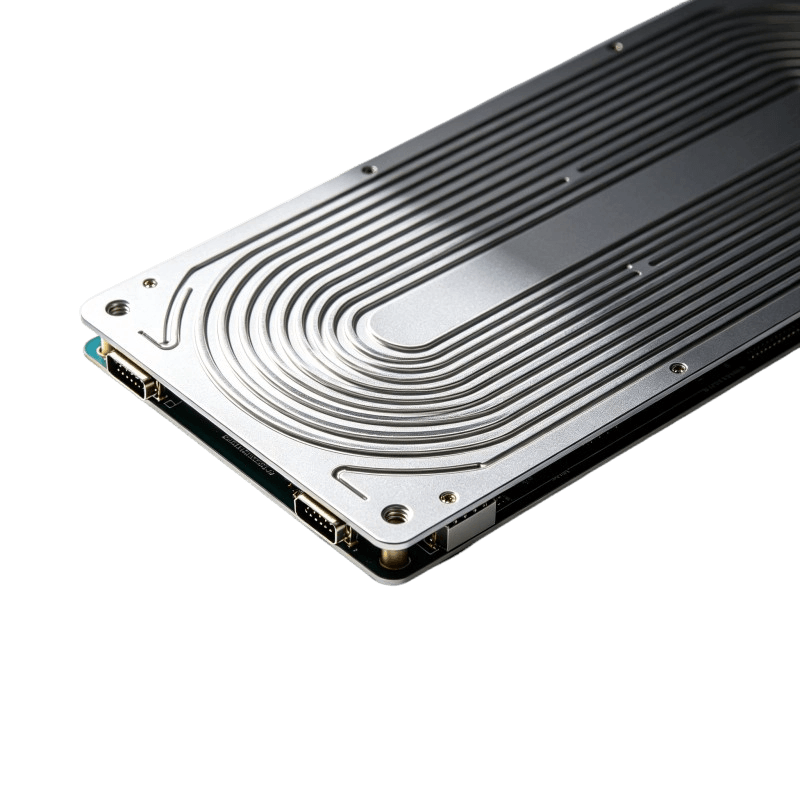
Liquid Cooling Cold Plate
The liquid cooling cold plate is the core heat exchange component of data center liquid cooling thermal control systems. It fits closely on the heating surface of high-power server chips, completing efficient heat exchange through internal cooling liquid circulation and rapidly removing concentrated heat generated by high-load operation of computing equipment.
CORE FEATURES
Flat laminar structure achieves tight fitting with heating surfaces.
Internal micro-channel structure improves overall heat exchange efficiency.
High thermal conductivity material accelerates rapid heat conduction.
Integrated sealing structure eliminates liquid leakage risks.
TECHNICAL SPECIFICATIONS
| Parameter | Specification |
| Dimension | Standard / customized fitting size |
| Weight | Lightweight flat structural design |
| Material | High thermal conductivity aluminum / copper alloy optional |
| Heat Exchange Level | Industrial standard liquid cooling efficiency |
| Interface | Standard pipeline connection port |
Liquid Cooling Cold Plate for Data Center Direct-to-Chip Cooling
As part of its Data Center Liquid Cooling Components portfolio, Jadecooling Tech provides Liquid Cooling Cold Plates for high-performance servers, AI computing platforms and high-density data center equipment. Designed for direct-to-chip thermal management, the cold plate transfers heat from high-power processors into circulating coolant through an internal channel structure.
A liquid cooling cold plate is installed in close contact with a heat-generating component, such as a CPU, GPU or AI accelerator. Heat is transferred through the cold plate base into the circulating coolant, which carries the absorbed thermal energy away from the chip and toward the cooling distribution system.
For server manufacturers and liquid cooling system integrators, cold plate selection requires careful evaluation of thermal contact, internal flow channel geometry, coolant flow rate, pressure drop, material compatibility and mechanical installation requirements.
Jadecooling Tech supports customized cold plate fitting dimensions, internal microchannel structure optimization and pipeline interface adjustments for different computing hardware configurations.
How Does a Liquid Cooling Cold Plate Work?
A liquid cooling cold plate operates through a combination of thermal conduction and liquid convection.
The cold plate is mounted against the heat-generating surface of a processor. Heat passes through the contact interface and conductive base into the internal coolant passages. As coolant flows through these passages, it absorbs heat and transports it away from the processor.
The main heat exchange process involves three stages:
1. Thermal Contact with the Heat Source
The cold plate base establishes a thermal interface with the CPU, GPU or other high-power electronic component.
The contact surface, mounting arrangement and interface material influence the thermal resistance between the heat source and the cold plate.
2. Heat Transfer Through the Cold Plate
The heat conducted through the base is distributed toward the internal coolant passages.
The base material, thickness and internal channel arrangement affect how effectively heat reaches the circulating coolant.
3. Coolant Heat Absorption and Transportation
Coolant flows through the internal channels, absorbs heat and carries it toward the downstream cooling circuit.
The heated coolant then returns to the coolant distribution system for further heat rejection and recirculation.
Key Design Considerations for Data Center Liquid Cooling Cold Plates
1. Thermal Contact Surface and Mounting Compatibility
The contact surface is a critical part of cold plate performance.
For CPU and GPU cooling applications, the cold plate must align with the target chip package and maintain appropriate contact conditions during operation.
Important considerations include:
-
Heat source dimensions and contact area.
-
Cold plate base flatness.
-
Mounting hole positions and spacing.
-
Contact pressure and fastening structure.
-
Thermal interface material compatibility.
-
Clearance around nearby electronic components.
A properly matched contact interface helps reduce unnecessary thermal resistance between the chip and the cooling plate.
2. Internal Microchannel Structure
Internal microchannels provide passages for coolant circulation and increase the contact area between the coolant and the cold plate structure.
The channel geometry influences coolant distribution, heat exchange efficiency and hydraulic resistance.
When developing a custom microchannel cold plate, engineers should consider:
-
Channel width and depth.
-
Channel arrangement and distribution.
-
Coolant inlet and outlet positions.
-
Flow distribution across different thermal zones.
-
Internal surface characteristics.
-
Manufacturing and sealing requirements.
The optimal channel design should balance heat transfer performance with pressure drop and manufacturing feasibility.
3. Thermal Resistance and Heat Exchange Efficiency
Thermal resistance describes the difficulty of transferring heat through a cooling structure.
For direct-to-chip liquid cooling, the overall thermal path includes the chip interface, cold plate base and coolant-side heat transfer.
Several factors influence the result:
-
Thermal conductivity of the selected material.
-
Contact quality between the heat source and cold plate.
-
Base thickness and internal geometry.
-
Coolant inlet temperature.
-
Coolant flow rate.
-
Internal channel structure.
For high-power AI and HPC applications, thermal evaluation should be performed under representative operating conditions rather than relying on material conductivity alone.
4. Coolant Flow Rate and Pressure Drop
Coolant flow rate and pressure drop are closely related to cold plate hydraulic performance.
Increasing flow rate may improve heat removal, but it can also increase hydraulic resistance and pumping requirements.
Buyers should consider:
-
Required coolant flow rate.
-
Internal channel dimensions.
-
Pressure drop across the cold plate.
-
Coolant viscosity and operating temperature.
-
Pumping capacity of the circulation system.
-
Flow distribution across the heat exchange area.
The cold plate should be evaluated together with the pipeline network, manifold and coolant distribution unit to ensure that the complete liquid cooling loop meets its hydraulic requirements.
5. Material Selection and Coolant Compatibility
Jadecooling Tech offers aluminum and copper alloy material options for customized cold plate development.
Different materials have different thermal conductivity, density, mechanical properties and manufacturing characteristics.
Material selection should consider:
-
Required thermal conductivity.
-
Overall product weight.
-
Structural strength and durability.
-
Coolant chemical compatibility.
-
Corrosion resistance.
-
Manufacturing and joining processes.
Special attention should be given to the compatibility of wetted materials within the complete cooling loop. For example, copper and aluminum used together in a coolant circuit may introduce galvanic corrosion risks under certain fluid and operating conditions.
Therefore, the cold plate material should be evaluated alongside the coolant formulation and other connected components.
6. Sealing Performance and Leakage Prevention
Sealing reliability is essential for direct-to-chip liquid cooling systems because coolant leakage can damage nearby electronic components and interrupt server operation.
A reliable cold plate design should consider:
-
Internal channel sealing.
-
Connection port sealing.
-
Joining and assembly quality.
-
Pressure resistance.
-
Thermal cycling conditions.
-
Leakage inspection and validation.
For OEM projects, buyers should confirm the required pressure test method, leakage acceptance criteria and inspection documentation before mass production.
Custom Liquid Cooling Cold Plate Development
Jadecooling Tech supports customized Liquid Cooling Cold Plate development for server manufacturers, AI hardware developers, GPU computing platform manufacturers and data center liquid cooling system integrators.
Customization can be evaluated according to the following project requirements:
-
Fitting Dimensions: Customize the overall dimensions and contact surface according to different CPU, GPU and accelerator packages.
-
Internal Microchannel Structure: Optimize the internal flow channel arrangement according to thermal load and coolant circulation requirements.
-
Material Selection: Evaluate aluminum or copper alloy options according to thermal, mechanical and coolant compatibility requirements.
-
Interface Position and Specifications: Adjust coolant inlet and outlet positions and connection specifications to match the system layout.
-
Integrated Sealing Structure: Review the sealing arrangement according to operating pressure and assembly requirements.
-
Mechanical Installation: Adapt mounting positions and structural dimensions to the target server platform.
For customized development, customers can provide chip specifications, 2D drawings, 3D models, thermal requirements or existing product samples for engineering evaluation.
The development process should consider thermal performance, hydraulic characteristics, mechanical compatibility and manufacturing feasibility together.
What Should Buyers Prepare Before Ordering a Custom Liquid Cooling Cold Plate?
Providing complete technical information helps suppliers evaluate cold plate design feasibility and prepare a more accurate quotation.
Before requesting a quotation, buyers should prepare:
-
Heat Source Specifications: Provide the CPU, GPU or accelerator model and its thermal design requirements.
-
Thermal Load: Specify the target heat load and expected operating conditions.
-
Mechanical Drawings: Provide chip package dimensions, mounting hole positions and available installation space.
-
Coolant Information: Identify the coolant type, chemical composition and operating temperature range.
-
Flow Requirements: Provide the target coolant flow rate and allowable pressure drop.
-
Material Requirements: Specify preferred aluminum or copper alloy options and any coolant compatibility restrictions.
-
Interface Requirements: Confirm coolant inlet and outlet positions, connection dimensions and pipeline arrangements.
-
Order Information: Provide prototype quantities, expected production volume and customization requirements.
These details help the engineering team assess the cold plate structure, internal flow path and system compatibility before prototype development.
Applications of Liquid Cooling Cold Plates
Liquid Cooling Cold Plates are used in computing environments where concentrated heat generated by high-power electronic components requires direct liquid cooling.
Typical applications include:
-
AI Servers: Transfers heat from high-power AI processors and GPU accelerators into the circulating coolant.
-
High-Performance Computing (HPC): Supports thermal management for processors operating under intensive computing workloads.
-
Cloud Data Centers: Provides direct-to-chip cooling for high-density server infrastructure.
-
GPU Computing Platforms: Supports customized thermal interfaces and coolant flow paths for graphics processing hardware.
-
Industrial Computing Equipment: Provides liquid cooling for industrial electronic systems with demanding thermal requirements.
Related Data Center Liquid Cooling Components
A complete direct-to-chip liquid cooling system requires coordinated operation between the cold plate, coolant pipelines, connectors and distribution components.
-
Liquid Cooling Quick Connector: Provides detachable coolant connections for convenient installation and maintenance. Explore our Liquid Cooling Quick Connector.
-
Liquid Cooling Pipeline Network: Transports coolant between cold plates, manifolds and distribution points. Explore our Liquid Cooling Pipeline Network.
-
Manifold: Distributes coolant across multiple cooling branches and collects return liquid from different cooling modules. Explore our Manifold.
Coordinating these components helps establish an integrated coolant circulation architecture for AI servers, HPC systems and high-density data centers.
Frequently Asked Questions About Liquid Cooling Cold Plates
1. What Is a Liquid Cooling Cold Plate?
A Liquid Cooling Cold Plate is a heat exchange component installed in contact with a heat-generating electronic device. Coolant circulates through internal passages to absorb heat conducted from the chip and transport it into the cooling system.
2. What Is the Difference Between a Liquid Cooling Cold Plate and a Heat Sink?
A conventional heat sink generally transfers heat into the surrounding air through natural or forced convection. A liquid cooling cold plate transfers heat into circulating coolant through internal channels, making it suitable for direct-to-chip cooling applications with concentrated thermal loads.
3. Are Aluminum or Copper Cold Plates Better?
Both materials can be used in liquid cooling cold plate applications. Copper generally offers higher thermal conductivity, while aluminum can provide advantages in weight and manufacturing cost. The appropriate selection depends on thermal requirements, mechanical design, coolant compatibility and overall system cost.
4. What Is the Role of Microchannels in a Liquid Cooling Cold Plate?
Microchannels provide internal passages for coolant circulation and increase the contact area between the coolant and the cold plate structure. Their dimensions and arrangement influence heat transfer, coolant distribution and pressure drop.
5. How Do I Choose the Right Cold Plate for a GPU or CPU?
Consider the chip model, thermal load, contact surface dimensions, mounting requirements, coolant flow rate, pressure drop and operating temperature. The cold plate should be matched to the actual hardware layout and cooling system.
6. Can Liquid Cooling Cold Plates Be Customized?
Yes. Jadecooling Tech supports customization of fitting dimensions, internal microchannel structures, material options and pipeline interface positions according to project requirements.
7. How Is Leakage Performance Evaluated for a Liquid Cooling Cold Plate?
Leakage performance can be evaluated through appropriate pressure and leak testing methods based on the product design and customer requirements. Buyers should confirm the test pressure, acceptance criteria and inspection documentation before production approval.

COMPATIBILITY
Compatible with mainstream high-power server chips and standard data center liquid cooling circulating systems.
APPLICATION SCENARIOS
Data center high-performance servers, cloud computing high-load equipment, industrial high-power computing hardware.


CUSTOMIZATION CAPACITY


Supports full customization of fitting dimensions.


Supports optimization of internal micro-channel structure.


Supports personalized adjustment of interface position and specification.