What Are the Advantages of Custom-Designed CPU Heat Sinks
Nov. 09, 2026
A processor that throttles during sustained workloads, a cooler that blocks nearby memory, or a fan that becomes distracting under load can turn a standard build into a frustrating one. Custom-designed CPU heat sinks let engineers target the actual thermal load, enclosure, and airflow rather than relying on a one-size-fits-all part. For teams evaluating a custom CPU heat sink for high-performance processors or CPU heat sink design for compact systems, the key measures are thermal management, heat dissipation, and airflow. The design also depends on thermal resistance, fin density, and the TIM (thermal interface material), so a complete evaluation matters more than appearance alone.
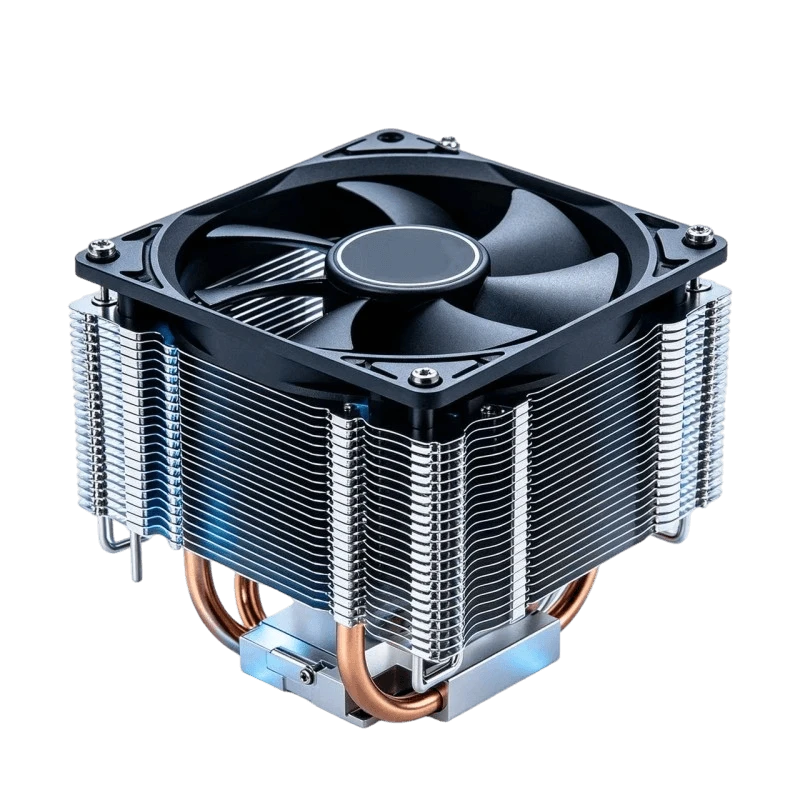
How a CPU Heat Sink Supplier can tailor cooling to the real workload
A stock cooler is designed to serve a broad range of systems. That can be practical, but it may not account for a particular processor power limit, chassis height, fan curve, acoustic target, or neighboring components. A custom design starts with those constraints and turns them into requirements that can be checked.
Start by defining the heat source and operating conditions. Record the processor’s sustained and peak package power for the intended workload, the ambient air temperature near the cooler inlet, the available space, and the system’s permitted noise level. Processor power varies by model, firmware, and workload, so a headline TDP should not be treated as a guaranteed measurement of heat during every use case. Confirm the relevant values with the processor documentation and system testing.
Next, the design team assesses the heat path from the processor package through the TIM and base, into the fins or heat pipes, and finally into moving air. Each interface adds resistance. A larger fin stack alone does not guarantee better cooling: if the fan cannot push air through closely spaced fins, or hot air recirculates inside the case, the system may not meet its target.
CPU heat sink design for compact systems and clearance limits
In compact workstations, embedded computers, and dense server layouts, millimeters can determine whether a cooler fits. A custom base shape, offset fin stack, or adjusted heat-pipe route can preserve clearance around memory, power components, cables, and the case lid. The design must also respect socket hardware and motherboard component heights, not just the processor’s outline.
Before approving a drawing, check the complete assembly envelope, including fan clips, connector access, mounting pressure, and service access. A design that fits a bare motherboard may still interfere with a cable or enclosure panel once installed. Jadecooling Tech can be considered as a supplier during this stage, but buyers should request dimensional drawings and verify fit against their own board and chassis.
Performance advantages of a custom CPU heat sink
The clearest advantage is the ability to tune the cooler to a stated thermal and mechanical target. The following calculation illustrates how thermal resistance can help compare designs; it is an example, not a measured result from a particular product.
If a heat sink’s measured sink-to-air thermal resistance is 0.25 °C/W under a defined test setup and it must dissipate 100 W, the estimated temperature difference between the sink base and inlet air is 25 °C: 100 W × 0.25 °C/W. This does not equal processor junction temperature. The processor package, TIM, contact pressure, airflow, and measurement method also affect junction temperature. That distinction is why a credible comparison records test conditions and measures the complete system.
More useful heat dissipation through geometry matched to airflow
Custom fin height, thickness, spacing, base area, and heat-pipe placement can be selected for the available fan and air path. Wider spacing may reduce airflow resistance in a low-pressure setup, while a dense fin stack can make sense when the fan and ducting can drive air through it. The right choice depends on measured fan performance and the enclosure, not on fin count alone.
Material selection also involves trade-offs. Aluminum is widely used where low mass and manufacturable fin structures matter. Copper conducts heat more readily than aluminum, but it is denser and can raise material and shipping costs. Heat pipes or vapor chambers can spread heat across a larger fin area, but their performance depends on orientation, heat load, construction, and operating conditions. A supplier should explain why a proposed structure suits the use case rather than simply listing materials.
Better fit, acoustic control, and system integration
A cooler designed around the actual chassis can direct air toward an exhaust path, avoid recirculation, and make room for nearby components. This can improve system-level thermal behavior without assuming that a larger fan or faster fan speed is always acceptable. If a noise limit is important, define how and where sound will be measured, then evaluate temperature and noise together at the same workload.
Custom engineering can also reduce compromises in mounting, cable routing, and maintenance. For a product made in volume, the design may be adapted to an assembly process or a particular retention mechanism. However, any change to mounting pressure or contact geometry needs validation; excessive or uneven force can damage hardware or produce inconsistent thermal contact.
What the CPU Heat Sink Supplier design and validation process should include
A dependable project moves from requirements to production through reviewable steps. First, provide the supplier with processor and socket details, sustained and peak workload power, ambient conditions, enclosure drawings, available airflow, height and width limits, acoustic requirements, expected annual volume, and applicable material or compliance requirements. The more complete the input, the less likely the first prototype is to solve the wrong problem.
The supplier can then propose a concept and explain its expected heat path, materials, manufacturing method, and key risks. Thermal simulation may help compare concepts, but it relies on assumptions about contact, airflow, and boundary conditions. Treat simulation as a design tool, not proof of final performance.
For prototypes, agree on a test plan before testing begins. It should specify the processor or calibrated heater, power level, workload duration, ambient temperature, fan speed, case configuration, sensor locations, and acceptance limits. Repeatable testing matters: changing the fan curve or opening the case can change results enough to make an otherwise neat comparison misleading.
Once a prototype meets the agreed targets, review production details such as dimensional tolerances, surface flatness, TIM application, mounting hardware, corrosion protection where relevant, and inspection criteria. Ask how the supplier controls variation between units and what happens if a production sample falls outside the approved limits. Jadecooling Tech and other prospective suppliers should be evaluated on documented capability, communication, sample quality, and production controls—not on a performance promise without test conditions.
Trade-offs to consider before choosing a custom CPU heat sink
Customization takes engineering time and usually costs more upfront than selecting an existing cooler. A new extrusion die, casting tool, machining setup, or specialized assembly may add non-recurring cost and extend the schedule. At low volumes, that expense may outweigh any gain. Ask for the total cost at the expected volume, including tooling, prototypes, packaging, and replacement parts, rather than comparing only unit prices.
There is also a design risk: a custom part can miss its thermal target if the workload, airflow, or contact assumptions are wrong. A very dense fin arrangement, for example, may restrict the actual fan’s airflow. A heavy copper assembly may create mounting or transport concerns. These risks are reduced by sharing accurate system information, reviewing prototypes early, and testing in the final enclosure under representative workloads.
Finally, a custom heat sink does not solve every cooling problem. Poor case ventilation, excessive processor voltage, an unsuitable fan curve, or an incorrectly applied TIM can remain the limiting factor. Diagnose the whole system before commissioning a new cooler. If an off-the-shelf part already fits and meets the required temperature and acoustic limits, customization may add complexity without practical benefit.
Is a custom CPU heat sink worth using?
It is worth evaluating when standard coolers cannot meet a verified requirement: unusual dimensions, a specific mounting arrangement, sustained heat loads, a controlled airflow path, or a defined noise target. It can also make sense for a product program where repeatable fit and assembly are important across many units. The decision should be based on prototype results and lifetime cost, not an assumption that custom automatically means cooler or quieter.
For a single desktop build, compare available coolers first and check the processor, socket, case clearance, and measured workload. For a commercial or embedded product, request a feasibility review and an agreed validation plan from the CPU Heat Sink Supplier. Make sure the supplier can show how thermal resistance, fin density, and TIM selection relate to the stated operating conditions.
In short, custom-designed CPU heat sinks are most useful when the application has constraints that a standard cooler cannot satisfy. Buyers should compare thermal management, heat dissipation, and airflow in the final system, and should verify thermal resistance, fin density, and TIM performance under repeatable conditions. Teams building compact systems or high-performance processors can begin with a custom CPU heat sink for high-performance processors or CPU heat sink design for compact systems, then select a CPU Heat Sink Supplier such as Jadecooling Tech only after reviewing fit, test data, cost, and production controls.