Core Structural Differences Between Embedded Heat Pipe Assembly & Microchannel Liquid Cold Plate in Passive-Active Hybrid Thermal Dissipation
Jun. 29, 2026
As electronic hardware continues evolving toward compact outline and rising power density, hybrid passive-active cooling configurations gradually replace single air-cooled radiators across industrial control, medium-power server and new energy component scenarios, among which embedded heat pipe assembly and microchannel liquid cold plate become two mainstream core structural parts for customized thermal management solutions. Many overseas procurement engineers confuse application boundary and structural feature of these two core products, thus this article systematically sorts out material configuration, internal working mechanism, applicable load range and installation matching specifications from practical engineering perspective.
Embedded heat pipe assembly adopts fully sealed copper tube as basic heat conduction carrier, filled with low-boiling-point neutral working fluid inside the vacuum pipeline; the core heat transfer logic relies on phase change latent heat conversion instead of solid metal thermal conduction, which makes its equivalent thermal conductivity 8–12 times higher than pure copper substrate under same volume specification. Our factory’s standardized embedded heat pipe products select oxygen-free copper TP2 as pipe raw material, with internal sintered copper powder capillary structure to strengthen backflow of condensed working medium, avoiding dry-out failure under frequent temperature fluctuation between -20℃ and 120℃ working environment. The peripheral aluminum fin frame is fixed via vacuum brazing technology instead of traditional mechanical crimping, cutting interface thermal resistance down to below 0.04℃·cm²/W and improving long-term operation stability of whole assembly. This product is mainly customized for medium heat flux equipment ranging from 30W to 350W, including industrial drive power supply, medium-sized communication transceiver module and small-scale vehicle-mounted controller, featuring convenient bolt fixation and no need for auxiliary circulating pump or liquid pipeline layout, which greatly reduces post-installation maintenance cost for end clients.
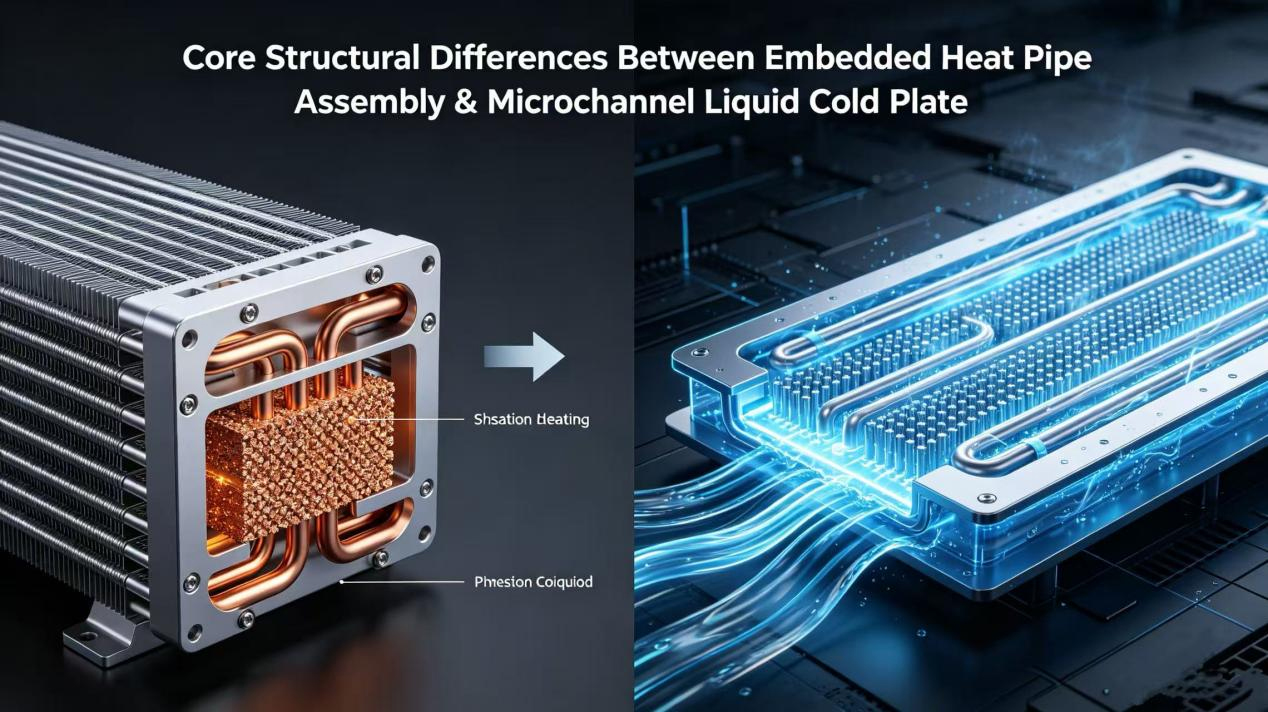
Differently, microchannel liquid cold plate belongs to active liquid-cooled core component, manufactured via deep hole drilling or friction stir welding (FSW) forming process, with dozens of micron-level dense flow channels distributed inside aluminum or copper substrate for coolant circulation to take away concentrated spot heat. Our microchannel cold plate series controls inner channel dimensional tolerance within ±0.03mm after CNC precision processing, optimizing flow velocity distribution to eliminate local hot spot caused by uneven coolant flow, which can steadily cope with heat load from 400W up to 3200W, widely matched with high-power IGBT module, server CPU cluster and new energy vehicle battery connection component cooling system. Unlike embedded heat pipe that works passively relying on phase change, cold plate must cooperate with CDU liquid distribution unit and external circulating pipeline, leading to higher overall system matching cost yet stronger continuous heat dissipation capacity under ultra-high power working condition.
From material cost and lifecycle input dimension, embedded heat pipe assembly owns lower unit purchase cost and simpler later maintenance, suitable for clients with limited cabinet internal space and medium power demand; microchannel cold plate targets long-running heavy-load industrial and automotive projects where equipment downtime loss far exceeds initial component procurement cost. Our technical sales team provides free thermal simulation calculation service for global buyers to select matched cooling structure according to actual equipment power curve and cabinet layout, avoiding over-spec or insufficient cooling configuration caused by blind product selection.