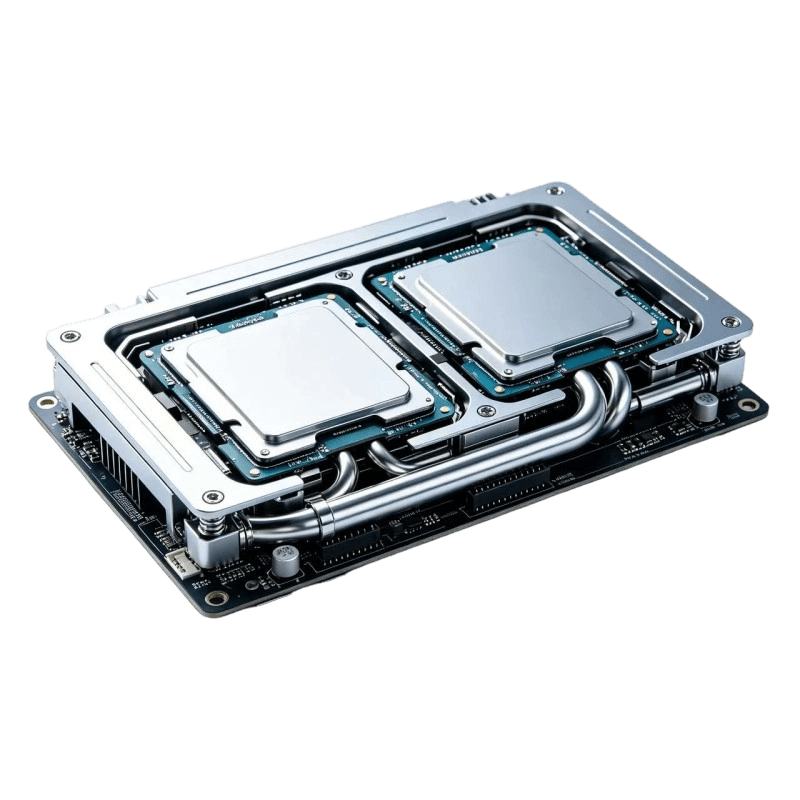
Dual-CPU Integrated Liquid Cooling Module
The dual-CPU integrated liquid cooling module is an integrated high-efficiency thermal control component for high-density dual-processor server equipment. It integrates dual-chip heat exchange structure and liquid circulation interfaces, realizing synchronous liquid cooling heat dissipation for two CPUs simultaneously and solving concentrated heat generation problems of high-power dual-processor server equipment in data center scenarios.
CORE FEATURES
Dual-CPU integrated design saves internal server assembly space.
Synchronous heat exchange structure ensures balanced temperature of dual chips.
Integrated interface layout simplifies overall liquid cooling system assembly.
High-efficiency circulation structure adapts to ultra-high power heat generation.
TECHNICAL SPECIFICATIONS
| Parameter | Specification |
| Dimension | Customized dual-processor fitting size |
| Weight | Integrated modular structural weight |
| Material | High thermal conductivity industrial alloy |
| Applicable TDP | Combined power range of dual high-power CPUs |
| Cooling Mode | Closed-loop liquid circulating heat exchange |
Dual-CPU Liquid Cooling Module for Dual-Socket Server Platforms
As part of its Data Center Liquid Cooling Components portfolio, Jadecooling Tech provides Dual-CPU Liquid Cooling Modules for high-density servers, AI computing platforms and high-performance computing (HPC) systems. The integrated module combines two CPU heat exchange structures with liquid circulation interfaces, supporting simultaneous thermal management for dual-processor server platforms.
Unlike two independent cooling components installed separately, an integrated dual-CPU cooling module coordinates the positioning, heat exchange structure and liquid connection layout of both processors within one assembly. This helps simplify cooling component integration and optimize the available installation space inside the server chassis.
For server manufacturers and OEM/ODM customers, selecting a suitable Dual-CPU Liquid Cooling Module requires evaluating CPU spacing, individual processor thermal loads, combined cooling requirements, coolant flow distribution and motherboard compatibility.
Jadecooling Tech supports customized dual-chip spacing structures, overall heat exchange optimization and integrated interface and pipeline matching for different server configurations.
How Does a Dual-CPU Liquid Cooling Module Work?
A Dual-CPU Liquid Cooling Module manages heat generated by two processors through an integrated liquid heat exchange structure.
Each CPU generates heat during operation. The module establishes thermal contact with both processors and transfers their heat into the circulating coolant through the corresponding heat exchange areas.
The basic heat exchange process involves three stages:
1. Dual-CPU Thermal Contact
The integrated module is positioned over two CPU packages on the server motherboard. Each heat exchange area must align with its corresponding processor to establish appropriate thermal contact.
The contact dimensions, mounting positions and pressure distribution should be evaluated according to the target motherboard layout.
2. Integrated Heat Exchange
Heat generated by both processors is transferred through the module's conductive structure into the circulating coolant.
The integrated design coordinates the two heat exchange areas within one assembly, helping reduce separate component installation requirements.
3. Coolant Circulation and Heat Removal
Coolant flows through the integrated liquid circulation structure, absorbs heat from the two processor cooling areas and carries the thermal energy toward the external cooling circuit.
The flow path and distribution arrangement should be evaluated according to the combined thermal load and hydraulic requirements of the target server platform.
Key Design Considerations for Dual-CPU Liquid Cooling Modules
1. CPU Spacing and Alignment
CPU spacing is one of the most important factors in developing a Dual-CPU Liquid Cooling Module.
Different dual-socket motherboards may have different processor center-to-center distances, socket positions and mounting arrangements.
The integrated cooling structure must match both CPU contact positions accurately.
Important considerations include:
-
Distance between the two CPU sockets.
-
CPU package dimensions and contact areas.
-
Mounting hole positions and spacing.
-
Height differences between surrounding components.
-
Clearance around memory modules and motherboard components.
-
Overall module dimensions and installation space.
For customized projects, motherboard drawings or 3D models can help determine the appropriate dual-chip spacing structure before prototype development.
2. Individual and Combined CPU Thermal Loads
A dual-processor server generates heat from two separate processors operating within the same system.
The cooling module should therefore be evaluated according to the thermal requirements of each CPU as well as their combined heat load.
Important factors include:
-
Individual CPU TDP.
-
Combined thermal load of both processors.
-
Expected simultaneous operating workloads.
-
Coolant inlet temperature.
-
Target processor operating temperatures.
-
Available coolant flow and heat exchange capacity.
The two processors may not always generate equal thermal loads. Their individual operating conditions should be considered when evaluating the integrated cooling structure.
3. Integrated Heat Exchange Structure
The heat exchange structure determines how thermal energy from both processors is transferred into the circulating coolant.
An appropriate design should consider the relationship between the two contact areas, conductive material, internal flow passages and overall structural dimensions.
The objective is to support effective heat transfer across both CPU positions while maintaining mechanical compatibility with the server platform.
4. Coolant Flow Distribution and Pressure Drop
Coolant flow distribution is another important consideration in dual-processor cooling applications.
Depending on the internal design, the cooling structure may use different flow path arrangements to serve the two heat exchange areas.
The appropriate configuration should be evaluated according to:
-
Individual CPU thermal requirements.
-
Combined coolant flow demand.
-
Internal channel dimensions.
-
Flow distribution between the two cooling areas.
-
Pressure drop across the module.
-
Inlet and outlet interface positions.
The module should be tested under representative operating conditions to assess thermal performance and hydraulic behavior.
5. Mechanical Integration and Installation Compatibility
An integrated module must fit the target server motherboard and chassis without interfering with other hardware components.
Compared with individual CPU cooling components, a dual-CPU integrated structure requires more careful consideration of the relative positions of both processors.
Before confirming the design, buyers should check:
-
Motherboard dimensions and CPU socket layout.
-
Available installation height.
-
Memory module clearance.
-
Nearby VRM and power component positions.
-
Mounting and fastening requirements.
-
Pipeline routing and connector accessibility.
These checks help reduce assembly conflicts and improve compatibility during server production.
6. Material Selection and Structural Stability
Material selection influences heat transfer efficiency, overall weight and mechanical stability.
The selected material should be suitable for the thermal requirements of both processors and compatible with the circulating coolant.
For customized projects, the engineering evaluation should consider thermal conductivity, structural strength, corrosion resistance and manufacturing feasibility.
The material selection should also be coordinated with the wetted components of the complete liquid cooling circuit to reduce potential compatibility and corrosion risks.
OEM & ODM Customization for Dual-CPU Liquid Cooling Modules
Jadecooling Tech supports customized Dual-CPU Liquid Cooling Module development for server manufacturers, AI hardware developers and liquid cooling system integrators.
Customization can be evaluated according to the following project requirements:
-
Dual-Chip Spacing Structure: Customize the distance and relative positioning of the two heat exchange areas according to the target motherboard layout.
-
Heat Exchange Efficiency: Evaluate and optimize the integrated thermal structure according to the individual and combined CPU thermal requirements.
-
Integrated Interface Layout: Adjust coolant inlet and outlet positions according to the server cooling architecture.
-
Pipeline Matching: Customize the integrated pipeline connection arrangement to match the corresponding liquid cooling system.
-
Overall Structural Dimensions: Optimize the module dimensions according to the available server installation space.
-
Mechanical Installation: Adapt mounting positions and fastening structures according to the target motherboard and CPU socket configuration.
For OEM and ODM projects, customers can provide motherboard drawings, CPU specifications, 3D models or existing cooling samples for technical evaluation.
From initial structural design to prototype evaluation and production preparation, the development process should consider thermal performance, hydraulic requirements, mechanical compatibility and manufacturing feasibility together.
What Should Buyers Prepare Before Ordering a Dual-CPU Liquid Cooling Module?
Providing accurate technical information helps the engineering team evaluate the cooling structure and prepare a more suitable customized solution.
Before requesting a quotation, buyers should prepare:
-
CPU Specifications: Provide the models, socket types and TDP ratings of both processors.
-
CPU Spacing: Share the center-to-center distance between the two CPU sockets and their mounting dimensions.
-
Thermal Requirements: Specify individual and combined CPU thermal loads and expected operating conditions.
-
Motherboard Drawings: Provide 2D drawings, 3D models and surrounding component layout information.
-
Coolant Specifications: Identify the coolant type, operating temperature and circulation requirements.
-
Flow and Pressure Requirements: Provide the required coolant flow rate, working pressure and allowable pressure drop.
-
Interface Requirements: Confirm coolant inlet and outlet positions, connector specifications and pipeline routing.
-
Order Information: Specify prototype quantities, estimated production volume and customization expectations.
These details help determine the appropriate dual-chip spacing, heat exchange structure and integrated liquid circulation interface before prototype development.
Applications of Dual-CPU Liquid Cooling Modules
Dual-CPU Liquid Cooling Modules are designed for computing equipment where two processors require coordinated liquid cooling within a shared assembly.
Typical applications include:
-
Dual-Socket Server Platforms: Supports integrated liquid cooling for servers equipped with two processors.
-
High-Performance Computing (HPC): Provides thermal management for dual-processor computing systems operating under intensive workloads.
-
AI Computing Infrastructure: Supports liquid cooling integration for high-density computing platforms using dual-processor server architectures.
-
Cloud Computing Servers: Provides integrated cooling structures for enterprise and cloud infrastructure.
-
Industrial Computing Equipment: Supports customized thermal management for industrial systems using dual-processor configurations.
Related Data Center Liquid Cooling Components
A complete direct-to-chip liquid cooling system requires coordinated operation between processor cooling modules, coolant pipelines and connection components.
-
Liquid Cooling Cold Plate: Provides direct thermal contact with CPUs, GPUs and other high-power chips. Explore our Liquid Cooling Cold Plate.
-
Liquid Cooling Pipeline Network: Transports coolant between the cooling module, manifolds and distribution equipment. Explore our Liquid Cooling Pipeline Network.
-
Liquid Cooling Quick Connector: Provides detachable coolant connections for convenient installation, replacement and maintenance. Explore our Liquid Cooling Quick Connector.
These components work together to support coolant circulation and thermal management in high-density server and data center applications.
Frequently Asked Questions About Dual-CPU Liquid Cooling Modules
1. What Is a Dual-CPU Liquid Cooling Module?
A Dual-CPU Liquid Cooling Module is an integrated thermal management assembly designed to cool two processors within a dual-socket server platform. It combines two heat exchange areas with liquid circulation interfaces in one integrated structure.
2. What Is the Advantage of an Integrated Dual-CPU Cooling Structure?
An integrated structure coordinates the positioning and cooling arrangement of both processors within one assembly. It can simplify component installation, optimize available space and support coordinated heat exchange for dual-processor server systems.
3. Can the Spacing Between Two CPU Cooling Areas Be Customized?
Yes. Jadecooling Tech supports customization of dual-chip spacing structures according to different motherboard layouts and processor socket positions. Buyers can provide technical drawings or 3D models for dimensional evaluation.
4. How Are the Cooling Requirements of Two CPUs Evaluated?
The evaluation should consider each processor's individual TDP, combined thermal load, operating conditions, coolant flow requirements and the temperature distribution across both heat exchange areas.
5. Is a Dual-CPU Liquid Cooling Module the Same as a Dual-CPU AIO Cooler?
Not necessarily. A dual-CPU integrated liquid cooling module may combine two heat exchange structures and coolant interfaces without including a pump, radiator or fan assembly. The complete supply scope should be confirmed according to the specific product configuration.
6. What Information Is Required for a Custom Dual-CPU Liquid Cooling Module?
Buyers should provide both CPU models, socket specifications, processor spacing, motherboard drawings, thermal requirements, coolant flow conditions, interface specifications and estimated order quantity.

COMPATIBILITY
Compatible with mainstream dual-CPU high-density server motherboards and standard data center liquid cooling systems.
APPLICATION SCENARIOS
Large data center high-performance computing servers, dual-processor industrial high-load equipment, cloud computing core server devices.


CUSTOMIZATION CAPACITY


Supports customization of dual-chip spacing structure.


Supports upgrade of overall heat exchange efficiency.


Supports integrated matching customization of interfaces and pipelines.